Garage Door Repair: Repair or Replace? How Plainfield Homeowners Decide
The average Plainfield homeowner deciding between repair and replacement usually asks the wrong question first: “How old is this door?” Age matters less than which parts have actually failed. A 15-year-old door with one broken spring almost always makes sense to repair. A 10-year-old door with a cracked bottom section, worn rollers, and a groaning opener is often cheaper to replace, but most people only discover that after paying for a repair that buys them six months. This guide walks through the decision the way we actually make it: part by part, not year by year. If you’d rather have a trained eye confirm the call, call (855) 707-0472 for a free estimate.
Why age alone is a bad test for a garage door in Plainfield
A 20-year-old Clopay or Wayne Dalton door with strong springs and a working opener can easily have another decade in it. A newer door that’s been banged around and neglected can be near the end. In our experience, the doors that last longest in Plainfield aren’t the newest ones. They’re the ones where a single worn part got fixed early instead of dragging three other components down with it.
What door age actually tells you is narrower than it sounds. It narrows the odds that a motor, a spring set, or a section is close to its limit. It doesn’t confirm it. That’s why a component-by-component audit beats a mileage-style guess every time. If you’re not sure what shape your door is in, a garage door repair visit is the fastest way to get a straight inventory of what’s failing and what’s fine.
What age does not tell you at all:
- Whether the springs were ever replaced (many have been, once, already)
- Whether the opener is a legacy unit or a newer connected model
- Whether the weatherstripping has quietly rotted out along the bottom
- Whether a single damaged panel is cosmetic or the start of a structural problem
- Whether the last repair used the right part for your specific door
That last point matters more than people expect. A Genie or LiftMaster opener behaves differently from a generic replacement, and a Clopay panel is not interchangeable with an Amarr panel. When parts get swapped without matching the brand, wear accelerates and the repair-or-replace math shifts fast.
The five-component audit: assess each part on its own
The decision stops being overwhelming once you split the door into five systems and judge each on its own terms. A whole-door verdict based on one bad part is how homeowners overspend. Here’s the framework we use.
- Springs. Springs carry the door’s weight. One broken spring on an otherwise healthy door is a straightforward repair. Springs that have both been replaced recently and failed again point to something else – wrong spring for the door weight, or a track issue adding load. Springs are under extreme tension and are genuinely dangerous to touch; we handle them as a dedicated safety service, not a general repair.
- Cables. Cables work with the springs. Fraying or a snapped cable often means the tension has been unbalanced for a while. A cable alone is repairable. Cables plus failing springs usually means the whole lifting system is due.
- Panels. A single dented bottom panel is a cosmetic fix you can live with or replace on its own. A cracked, rusted-through, or buckled panel is different – it can mean the door’s structure has lost integrity, and that pushes toward replacement.
- Opener. A noisy, struggling opener on an otherwise solid door is a repair, not a replacement. Opener repair is its own specialty, and modern connected units behave very differently from older ones.
- Weatherstripping. Cheap and easy. Failing seals let in drafts and moisture, which quietly accelerates wear on everything above. Fix the seal regardless of what you decide on the rest.
Put your door through that list and you’ll usually get a clear answer. Two or more failing systems plus an aging door leans replace. One failing system on a healthy door leans repair, every time.
The real cost math: when repairs start adding up
Repair-versus-replace comes down to what you’ll spend if you keep repairing, not what one repair costs today. The honest way to see it: add up your repair estimates over the next 24 months. If that total approaches or exceeds the price of a new door, replacement is the smarter move. Here’s how a typical set of Plainfield estimates breaks down, and what the numbers usually suggest.
- Single spring or cable repair: a modest repair, worth doing on an otherwise sound door
- Opener repair or replacement: a mid-range cost, worth doing if the door itself is healthy
- Panel replacement (one section): a moderate cost, and worth it only if the rest of the door is sound
- Full spring set plus cables plus rollers: a larger repair that starts to compete with a new door
- New door installation: a bigger investment that resets the clock on the whole system
The trap most estimates hide is labor overlap. If you fix a spring now, then the opener in four months, then a panel the year after, you pay the labor charge and the trip charge several times over. A single replacement visit spreads that labor once. When the 24-month repair total creeps toward replacement cost, you’re essentially financing a new door one repair at a time – without ever getting the new door.
Read every estimate for what’s quoted before work begins. Get the written price, per job, and confirm it won’t move once the technician is on site. That single habit prevents the unpleasant surprise of an invoice that grows after arrival.
What panel damage tells you about the whole door
Not all panel damage means the same thing. A dented bottom panel from a bumped bumper is a cosmetic issue – you can replace that one section and move on, or live with it. But certain panel problems signal structural compromise, and that changes the call.
Watch for these in Plainfield:
- Cracks that run through the panel rather than a surface dent
- Rust that’s eaten through the metal, not just staining it
- Sections that look bowed or buckled along the width of the door
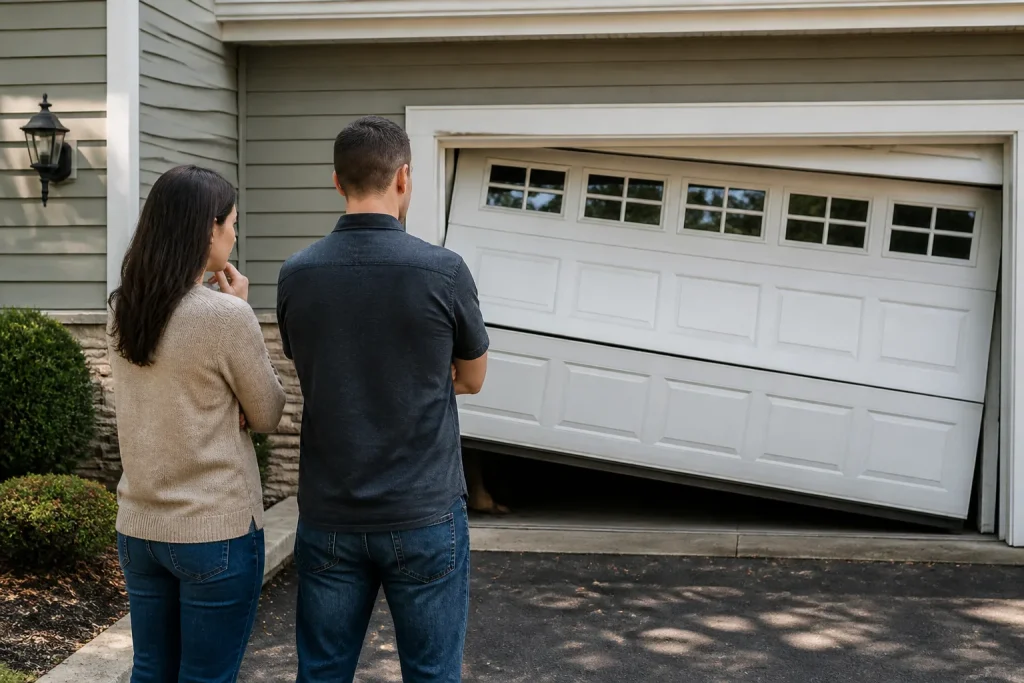
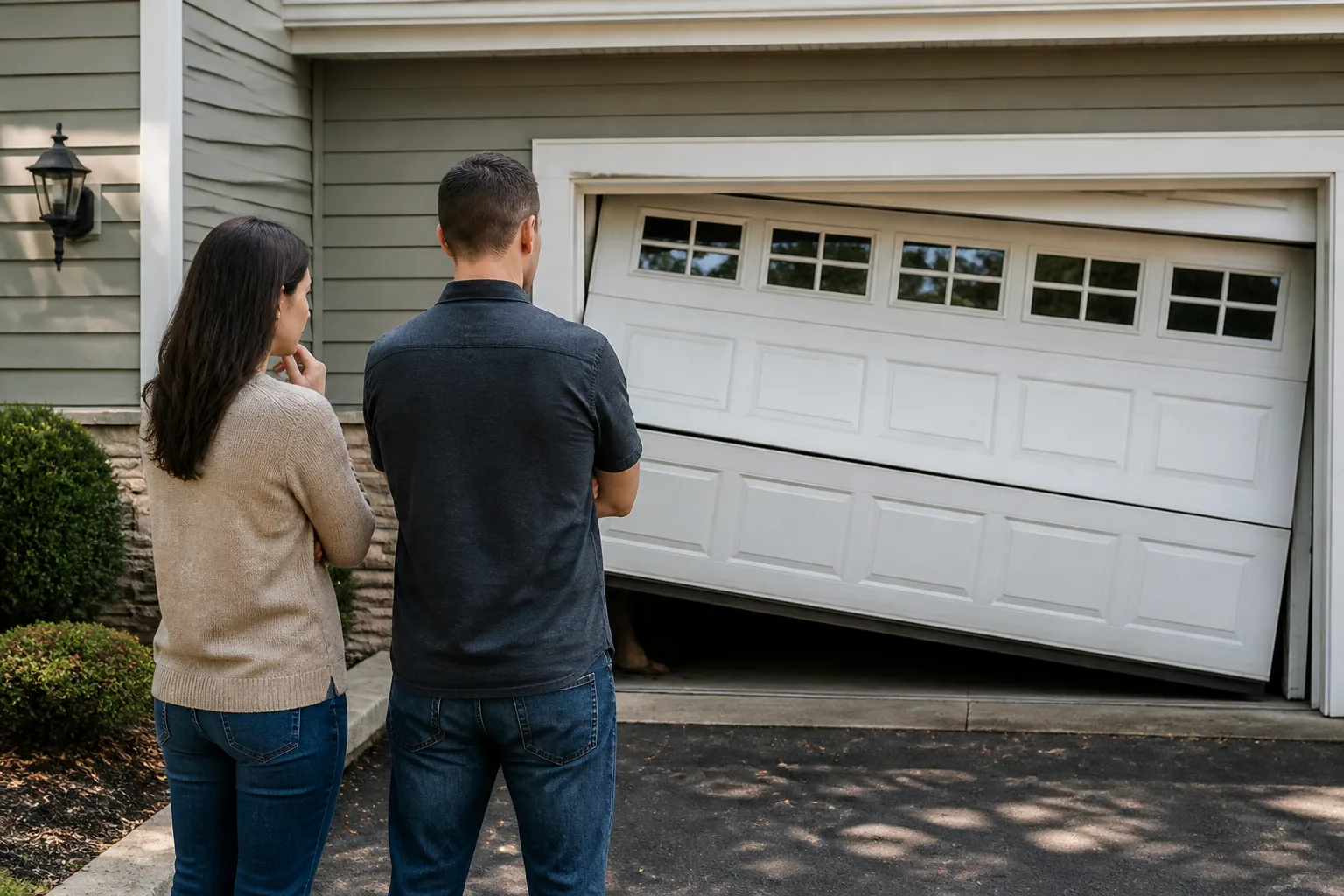
- A door that sags at one side or sits crooked in the frame
Any of those, combined with an aging door, tips the math toward full replacement. A buckled door is telling you the lifting system and the panel structure are both under strain. Patching one panel on a compromised frame rarely holds for long, and you end up back on the phone a year later. When the damage is cosmetic, repair it. When it’s structural, replacement usually serves you better over the next decade. A garage door spring repair visit can confirm whether the springs are the hidden cause behind that sag.
Questions to ask a technician before you commit
The clearest sign of an honest recommendation is a technician who can explain their reasoning part by part. They should be able to point at the spring, the cable, the panel, and tell you its actual condition – not just say “the whole thing needs replacing.” We work across brands like Genie, Clopay, Amarr, and Wayne Dalton specifically so we’re diagnosing your actual door rather than guessing at a generic workaround. But you should still feel comfortable asking these on any visit.
- “Which components have actually failed, and which are fine?” – a good answer lists them separately.
- “If I repair this, what’s likely to fail next, and roughly when?” – this shows whether they’re thinking 24 months ahead or just today.
- “Is the panel damage cosmetic or structural?” – the honest answer is sometimes “cosmetic, you can leave it.”
- “Is my opener the original unit or a replacement, and does it match the door weight?” – a mismatched opener causes repeat wear.
- “What’s the total if I repair now versus replace?” – ask for both, side by side.
If a recommendation comes back as “replace everything” without a component-by-component reason, get a second opinion. And if it’s a repair, make sure the price is quoted and agreed before any work starts.
When to call a pro
Some of this audit you can do safely from a distance – eyeballing panels, listening to the opener, checking the bottom seal. But springs and cables under tension are where a DIY inspection becomes genuinely unsafe. A stretched spring can release with enough force to cause serious injury, which is exactly why we treat spring work as a dedicated specialty rather than a quick fix. Don’t try to adjust, disconnect, or unwind a spring yourself. Leave that to a trained technician.
Call a professional when the door won’t open or close, when you hear a loud bang from the spring area, when the door moves unevenly, or when you’re simply not sure whether a repair buys you time or just delays the inevitable. For opener trouble, our garage door opener repair team diagnoses legacy and connected units alike. Plainfield doors face real seasonal stress, and getting a technician’s read on the whole system before you decide is worth one visit.
Related services in Plainfield: garage door repair, garage door spring repair, garage door opener repair, and full garage door installation. If your door is beyond repair, new installation is a straightforward next step rather than a dead end.
The Bottom Line
Repair or replace isn’t an age question – it’s a component question. Run the five-part audit: springs, cables, panels, opener, weatherstripping. One failing system on an otherwise healthy door leans repair. Two or more failures on an aging door, or structural panel damage, leans replace. Then do the 24-month math: if your cumulative repair costs start competing with a new door, replacement usually wins. Plainfield Garage Door Repair Co is the team behind Plainfield Garage Door Repair Co, and garage doors are all we do. If you’re in Plainfield and need help deciding, we offer free estimates and a written price quoted before any work starts. Call (855) 707-0472 to book yours.
Frequently Asked Questions
Repair is usually better when only one component has failed and the door’s structure is sound. Replace when two or more systems are failing at once, when a panel is cracked or buckled rather than just dented, or when 24 months of repairs would cost close to a new door. Call (855) 707-0472 for a free estimate to make the call with confidence.
Cost depends entirely on which component has failed, so a quote is always per job. Springs, cables, opener work, and panel replacement each carry different costs. The written estimate is the price, and it’s agreed before any work begins. Call (855) 707-0472 for an exact quote – estimates are free.
No. We quote the job and agree the price before any work starts, so the number you’re given is the number you can hold us to. If the on-site inspection turns up something different from what you described, we’ll talk it through before touching anything. Call (855) 707-0472 for a written quote.
Often, yes. Spring repair is a core service and timing depends on the parts and door involved, but we treat it as a genuine emergency option because a door that won’t lift leaves you stuck. For a repair need, call (855) 707-0472 and we’ll tell you what’s realistic for your door.
Yes – the local professionals we connect you with are licensed and insured as the state requires. Our technicians have up to 8 years of experience and work specifically on garage doors, across brands like Genie, Clopay, Amarr, and Wayne Dalton. Call (855) 707-0472 for a free estimate.
Written by the team at Plainfield Garage Door Repair Co.
Need Garage Door Help?
Call Plainfield Garage Door Repair Co - the local pro we connect you with is licensed and insured, here with fast after-hours help in Plainfield.
(855) 707-0472